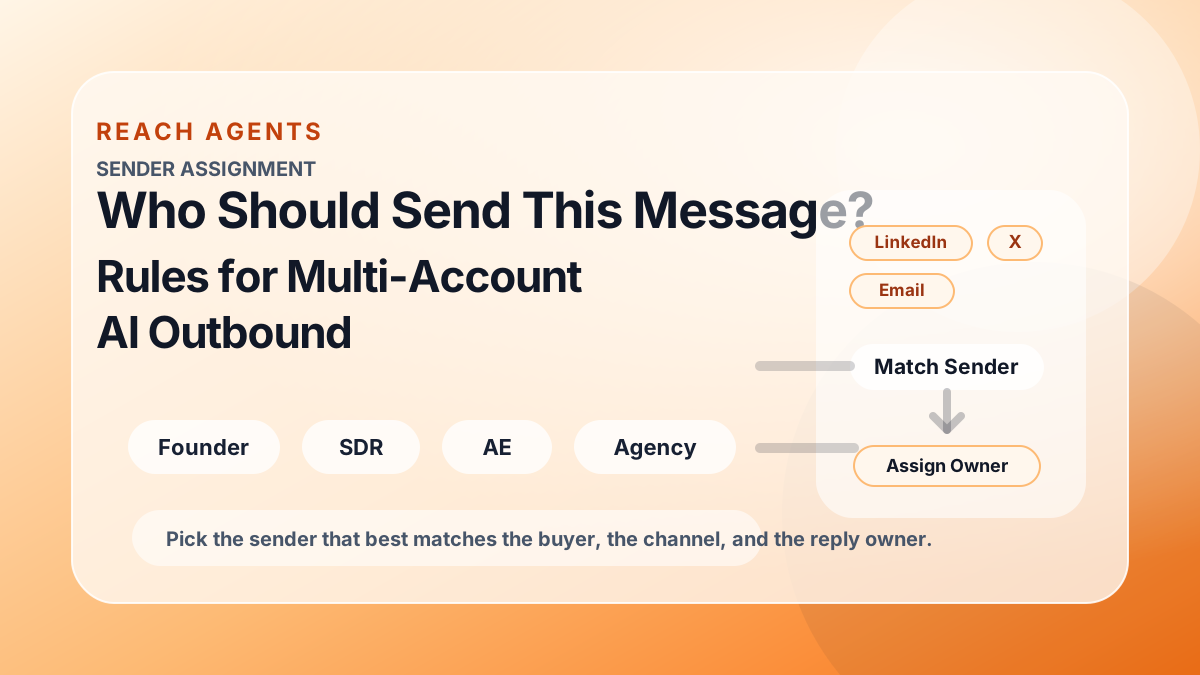
Who Should Send This Message? Sender Assignment Rules for Multi-Account AI Outbound
Most outbound teams spend a lot of time deciding what to say and not enough time deciding who should say it.
That becomes a real problem once the team connects multiple LinkedIn, X, and email accounts. Suddenly there is more coverage, more capacity, and more flexibility, but there is also more room for confusion:
- two senders can reach the same buyer
- the wrong sender can make a good message feel generic
- replies can land in an account nobody is actively watching
- approval gets slower because ownership is unclear
In multi-account outbound, sender assignment is not an admin detail. It is part of message quality.
A strong reason-to-message can still underperform if the sender identity does not fit the buyer, the channel, or the next step. A weaker sender match can also create operational noise even when the copy itself looks fine.
This article picks up where the Reach Agents cluster on connected accounts, approval workflow, and reply routing leaves off. Once the accounts are connected and the campaign rules exist, the next question is simple:
Which account should send this specific message to this specific buyer?
1. Why sender assignment becomes a growth and governance problem fast
Sender assignment usually breaks in predictable ways.
The team adds a founder inbox, two SDR inboxes, one AE account, and maybe a shared agency-managed sender. The system now has enough supply to contact more buyers, but the logic for matching sender to buyer is still vague.
That creates three common failure modes.
Duplicate touches
Two accounts end up reaching the same person because nobody locked ownership at the account, company, or contact level.
Weak sender-prospect fit
The message is directionally correct, but the sender is wrong. A founder message is sent from a junior SDR. A technical buyer gets a message from someone who cannot handle the follow-up. A social-first conversation starts from an account with no visible context or credibility.
Reply ownership confusion
The prospect answers, but it is not obvious who should continue the conversation. The sender owns the inbox, but a different person owns the account strategy, and a third person would actually run the call.
This is why sender assignment is not only about capacity planning. It sits at the intersection of:
- buyer relevance
- message credibility
- operational ownership
- reply handling
- brand safety
If those do not stay aligned, adding more connected accounts creates more entropy than leverage.
2. The four inputs every sender decision should use
A useful sender assignment rule does not need to be complicated. It just needs to evaluate the right inputs in the right order.
1. Buyer relationship and buyer type
Ask:
- Is this a founder, operator, RevOps leader, SDR manager, or agency owner?
- Does the buyer expect peer-to-peer outreach, team-led outreach, or account-owner outreach?
- Is there already a relationship, shared context, or warm path?
Some buyers respond better when the sender has obvious role parity. Others mainly need a clear operational owner.
2. Channel and message weight
Ask:
- Is the first touch happening on LinkedIn, X, or email?
- Is the opener lightweight and social, or more direct and commercial?
- If the buyer replies, will the conversation stay short or turn into a more serious evaluation quickly?
A sender that works well for a short LinkedIn opener may be a poor fit for a more detailed email exchange.
3. Sender credibility for this context
Ask:
- Does this sender have enough authority, relevance, or functional fit for the angle?
- Would the buyer understand why this person is reaching out?
- Can the sender naturally own the promised next step?
This is the difference between an outreach motion that feels intentional and one that feels randomly assigned.
4. Operational readiness and ownership
Ask:
- Who owns this account?
- Who approves messages from it?
- Who monitors replies?
- Is the channel actually active and safe to use right now?
If the account is not monitored or the ownership is unclear, it is not ready, even if the sender identity looks good on paper.
A practical rule is simple:
The best sender is the account that creates the strongest buyer fit without creating reply or governance ambiguity.
3. When founder, SDR, AE, or agency accounts should send
The easiest way to avoid bad sender choices is to define default rules for each sender type.
Founder accounts
Founder-led outreach is strongest when:
- the target buyer is also a founder or senior operator
- the message depends on vision, product direction, or category insight
- the account is strategic enough that sender identity materially changes response quality
- the next step may involve higher-trust product or GTM discussion
Founder accounts are weaker when:
- the segment is broad and operationally repetitive
- the founder cannot realistically monitor and own replies
- the motion needs consistent day-to-day follow-up rather than selective high-trust touches
Founder accounts should be treated like scarce trust assets, not generic sending capacity.
SDR or BDR accounts
SDR accounts are strongest when:
- the segment is well-defined and repeatable
- the outreach angle is operational and clearly within the sender's lane
- follow-up needs consistency more than seniority
- the team wants clean ownership for first-touch volume and day-to-day response handling
They are weaker when:
- the message depends on executive-to-executive relevance
- the buyer is likely to test strategic depth immediately
- the sender cannot credibly own the conversation beyond the opener
AE or sales-owner accounts
AE accounts are often right when:
- the buyer is already closer to evaluation or expansion
- the first touch is more account-specific than list-based
- the sender may need to handle objections, qualification, or scheduling quickly
- the motion overlaps with active opportunity ownership
AE senders usually work best when the campaign is selective and closer to pipeline creation than broad top-of-funnel sourcing.
Agency or shared-service accounts
Shared or agency-managed accounts can be useful when:
- the team runs outbound for several clients or business units
- the sender is clearly mapped to a specific client, offer, or workspace
- the agency can maintain approval and reply discipline for that account
They become risky when:
- the sender identity is generic
- reply ownership crosses too many people
- the buyer cannot easily understand who is contacting them and why
Shared capacity only helps when ownership stays legible.
4. Sender rules should change by channel, not just by role
Many teams try to use the same sender logic across LinkedIn, X, and email. That usually makes sender assignment feel tidy internally and weaker externally.
Each channel changes what the buyer sees and expects.
LinkedIn makes sender identity highly visible.
Buyers can immediately see role, company, activity, and whether the sender looks like a plausible person to start this conversation. That means LinkedIn sender assignment should prioritize:
- role credibility
- profile quality
- account monitoring discipline
- relevance between sender identity and message angle
If the sender profile does not support the message, LinkedIn makes that obvious fast.
X
X is more timing-sensitive and personality-sensitive.
The best sender on X is usually someone who can naturally participate in the kind of public or semi-public conversation the buyer already has there. This is especially important when the opener is based on a recent post or reply.
Use X senders when:
- the buyer is visibly active there
- the sender account also feels live and credible
- the reply loop can be monitored closely
Do not treat X as a backup lane for accounts that are not truly active.
Email makes sender deliverability and reply ownership more important.
A verified work inbox is useful, but email sender assignment should still ask:
- does this inbox belong to the right person for this conversation?
- is the sender domain healthy enough for the volume and audience?
- who owns objections, referrals, and scheduling replies that land here?
That is why sender assignment connects directly to deliverability readiness, not just copy decisions.
5. How to prevent duplicate touches when more than one sender could work
Sometimes several accounts are technically valid.
A founder could send. An SDR could send. An AE might also make sense. When that happens, the answer is not to let every eligible sender compete for the same lead.
Use tie-break rules.
Lock one primary owner before send
Choose one owner at the lead or account level before any customer-facing action happens.
Prefer the narrowest good-fit sender, not the highest-status sender
If an SDR is clearly the right owner and can handle the conversation well, do not escalate everything to the founder just because the founder account looks more powerful.
Suppress parallel touches across channels
If one sender begins outreach on LinkedIn, a second sender should not quietly launch email two days later unless the workflow intentionally branches and ownership is still clear.
Pause on mixed ownership
If two teams believe they own the same prospect, that is a workflow problem, not a sequencing opportunity.
The sender decision should make the rest of the motion simpler. If it makes the motion harder to track, the rule is wrong.
6. Approval, routing, and escalation should inherit the sender decision
A sender assignment rule is only useful if the rest of the workflow respects it.
Once a sender is chosen, three downstream decisions should become clear immediately.
Who approves messages from this account?
Approval can differ by sender type, channel, or account value. A founder account may require review on nearly every strategic send. A well-calibrated SDR segment may only need review for first batches or high-risk triggers.
Who owns the reply if the buyer answers?
The answer should not be discovered after the fact. Reply ownership should be explicit before the first touch goes out.
When should the conversation escalate?
If the sender is not the best person to handle pricing, technical validation, procurement, or sensitive objections, the handoff rule should already exist.
This is where reply routing matters. Sender assignment is upstream of routing. If the sender is wrong, the routing logic becomes cleanup.
7. A sender assignment matrix teams can actually copy
A simple matrix is often enough to make the rules operational.
| Situation | Best default sender | Why |
|---|---|---|
| Founder targeting founder or VP-level buyer with a strategic angle | Founder account | Strongest trust and role parity |
| Repeatable outbound to a defined operator segment | SDR account | Better day-to-day ownership and scale discipline |
| Buyer may reply with qualification or scheduling questions quickly | AE or sales-owner account | Better fit for active conversation ownership |
| Agency running outreach for a client with clear workspace ownership | Client-mapped shared account | Keeps identity and ownership aligned |
| Social signal on X requires fast, conversational follow-up | Active X sender with matching voice | Timing and account credibility matter more than raw seniority |
| Verified email exists, but the founder will not monitor replies | SDR or AE inbox instead of founder inbox | Better operational continuity |
| Strategic account with mixed ownership across teams | Human review before assign | The assignment decision itself needs judgment |
If you are evaluating tooling, this matrix is also a good product test. A strong system should let the team express rules like these instead of forcing every sender into the same queue. That is one of the big checkpoints in how to evaluate AI outbound software in 2026.
8. Start with a small sender pool and promote accounts only after reply quality is real
The fastest way to make sender assignment messy is to connect too many accounts too early.
A safer rollout looks like this:
- connect a small sender pool with clear account ownership
- define which buyer segments each sender type can handle
- assign approval rules by sender and channel
- launch small batches with one owner per lead
- monitor reply quality, not just send volume
- expand only after the team can explain why each sender is earning more load
The goal is not maximum account utilization. The goal is accountable coverage.
A sender should earn more campaign share because:
- the buyer fit is strong
- reply quality is healthy
- ownership is clear
- the channel is monitored
- the handoff path works in practice
That is how multi-account outbound becomes a coordinated system instead of a collision risk.
Start free: connect LinkedIn, X, and email accounts, assign clear ownership, and let Reach Agents build reviewed outreach flows around the right sender at app.reachagents.ai.
Table of Contents
Ready to build your outbound workflow?
Book a walkthrough
Start using Reach Agents for free
Log in at app.reachagents.ai to connect your accounts and start launching outbound workflows.
Start free