Buying Signal Library: 25 Triggers to Feed an AI Outbound Agent
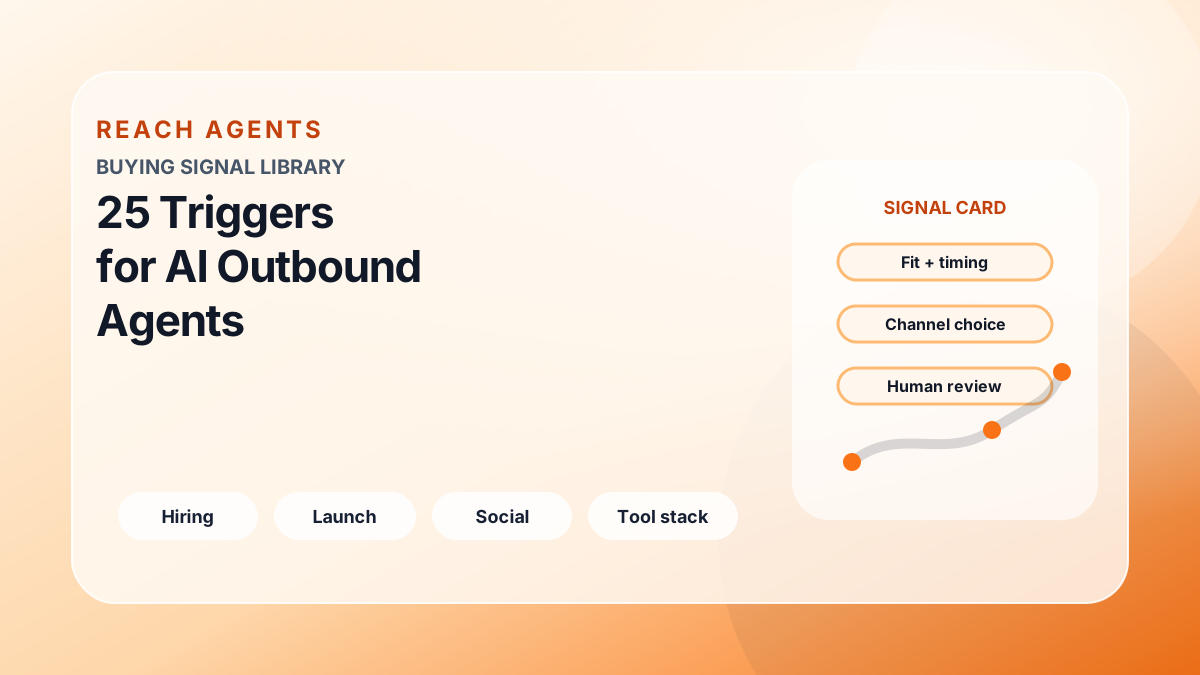
Signal-based outbound only works when the signal is specific enough to change the decision.
"This person is a VP of Sales" is not a buying signal. It is a role filter. "This VP of Sales is hiring SDRs while the company is expanding into a new market" is closer to a signal because it explains why now might be a reasonable time to reach out.
AI outbound agents need that difference. Without clear triggers, the agent turns into a list builder with better copy. With clear triggers, it can qualify buyers, explain why each account is worth reviewing, choose a safer first channel, and draft a message that feels connected to the buyer's actual context.
This library gives teams 25 triggers they can feed into an AI outbound workflow. Use it as a starting point, then tighten the list around your ICP, offer, channel mix, and approval rules.
1. Start by separating filters from triggers
A filter says who is in scope. A trigger says why this person or account is worth action now.
Useful filters include:
- company size
- geography
- industry
- role or title
- funding stage
- current tool category
- customer segment
Useful triggers include:
- a hiring plan that creates workflow pressure
- a product launch that changes go-to-market needs
- a public post that reveals pain
- a channel-specific engagement event
- a tool migration or vendor complaint
- a reply, bounce, or referral that changes the next step
The agent needs both. Filters prevent the system from chasing the wrong market. Triggers help it decide which in-scope accounts deserve a message, what evidence to show, and what a human should review.
If your ICP is still loose, start with ICP rules for AI outbound before adding triggers. Otherwise the agent will find interesting signals about the wrong buyers.
2. The 25 buying signals to test first
Treat this as a menu, not a checklist. Pick two or three that connect most directly to the problem your product solves.
| # | Trigger | Why it matters | Safer first move |
|---|---|---|---|
| 1 | Hiring SDRs, BDRs, or growth roles | The team is investing in outbound capacity and may need better prospecting, messaging, or reply handling | LinkedIn or email to the GTM owner with a workflow question |
| 2 | Hiring RevOps, sales ops, or lifecycle roles | The company is adding process ownership, reporting, routing, or tooling discipline | Email to the operator with a concrete setup angle |
| 3 | Opening a new market or geography | New segments often need new lists, channels, and messaging tests | Founder or GTM lead outreach tied to launch timing |
| 4 | Launching a new product or use case | A new motion creates pressure to find early buyers fast | LinkedIn or email with a small approved-campaign angle |
| 5 | Founder or executive posts about pipeline | The pain is public and executive-owned | Social-first reply or LinkedIn message referencing the public context |
| 6 | Job posts mention outbound tooling, sequencing, enrichment, or deliverability | The workflow need is visible in hiring language | Email or LinkedIn to the team owner with a tooling/process question |
| 7 | The company adds sales headcount after funding | Funding plus headcount often creates pipeline expectations | Founder/VP outreach focused on safe first-wave testing |
| 8 | New VP Sales, Head of Growth, or CRO joins | New leaders often audit pipeline systems and outbound motion | LinkedIn first, then email if the business reason is strong |
| 9 | Website or pricing page targets a new buyer persona | Messaging shift may require new prospect lists and channel rules | Email to growth or marketing owner with a persona-specific angle |
| 10 | Competitor comparison or alternative page goes live | The company is fighting for active category demand | Email with a buyer-discovery or campaign-quality angle |
| 11 | Public customer story names a repeatable segment | Customer proof reveals the next market to prospect | LinkedIn/email to founder or GTM owner with segment expansion idea |
| 12 | Product Hunt, launch community, or beta waitlist activity | The team needs fast learning from early users or buyers | Social-first outreach to a founder or growth lead |
| 13 | Open roles mention manual prospecting or list building | Manual work is visible inside the job description | Email to sales/growth ops with a list-quality angle |
| 14 | Sales team posts about low reply quality | The issue is not activity volume; it is fit, channel, or message relevance | LinkedIn conversation before any pitch |
| 15 | Team asks for tool recommendations publicly | The buyer is actively comparing options | Reply in-channel, then move to LinkedIn/email if welcome |
| 16 | Existing tool stack includes a sequencer but not strong discovery | The team may have sending capacity but weak buyer discovery | Email with "before the sequence" framing |
| 17 | Existing tool stack includes enrichment but weak approval workflow | The team may have data but not enough decision control | Email to RevOps with approval and QA framing |
| 18 | Domain or sender health discussion appears in public/community channels | Deliverability risk is already top of mind | LinkedIn or email with a triage/checklist angle |
| 19 | High social engagement from target accounts around a relevant pain | The account is paying attention to the problem space | Social-first message tied to the exact topic |
| 20 | Buyer comments on competitor or category content | The buyer is learning or evaluating | LinkedIn with a useful question, not a hard pitch |
| 21 | Company publishes a new integration or ecosystem page | The workflow is becoming more connected and operational | Email to partnerships, product, or RevOps depending on the integration |
| 22 | Agency or service firm announces new client capacity | They may need repeatable outbound without adding manual ops | Founder/operator outreach focused on scalable delivery |
| 23 | Event, webinar, or conference sponsorship in your category | The team is investing in market attention and follow-up | Email or LinkedIn around post-event buyer routing |
| 24 | Hiring pauses or lean-team language appears | The team may need leverage without more headcount | Founder-led message about controlled outbound capacity |
| 25 | Prior reply, referral, bounce, or wrong-person response changes the path | The signal comes from the campaign itself and should alter routing | Branch the workflow instead of continuing the old sequence |
The strongest trigger is not always the loudest one. It is the one that gives the reviewer a credible reason to say: this person fits, this timing makes sense, this channel is reasonable, and this message should be allowed to go out.
3. Score every signal by fit, timing, and evidence
A trigger becomes useful when the agent can explain it.
Before a prospect enters a campaign, ask the agent to produce a short signal card:
- Fit: why the company and person match the ICP
- Trigger: what changed or what evidence was found
- Timing: why outreach now is more reasonable than a generic touch
- Source: where the signal came from
- Confidence: what is known, what is assumed, and what is missing
- Channel recommendation: LinkedIn, X, email, or no send yet
- Review reason: what a human should approve or reject
A simple scoring model is enough:
| Score | Meaning | Recommended action |
|---|---|---|
| High fit + high timing + clear evidence | Strong reason to create a reviewed message | Draft for approval |
| High fit + weak timing | Good account, unclear reason now | Save or monitor for a stronger trigger |
| Weak fit + strong signal | Interesting but outside ICP | Suppress unless a human overrides |
| Unclear evidence | The agent found a hint, not a reason | Enrich or review before drafting |
| Sensitive or risky context | The trigger may be personal, speculative, or brand-sensitive | Require human approval or suppress |
This keeps the system from treating every detected fact as permission to send.
4. Match signal type to the first channel
The same trigger should not always produce the same channel.
Email is stronger when the context is business-specific, the buyer expects a direct workflow conversation, and the claim can be made clearly. LinkedIn is stronger when sender credibility and professional identity matter. X is stronger when the signal came from a public conversation and the message can stay lightweight.
A practical channel map:
| Signal type | Good first channel | Why |
|---|---|---|
| Hiring, funding, new market, new executive | LinkedIn or email | The business context is explicit enough for a direct message |
| Public post, comment, community thread | X or LinkedIn | The context is social and recent |
| Tool stack, job description, operations language | The workflow problem can be described more concretely | |
| Missing verified email but strong social signal | LinkedIn or X | Do not force an email-first path when the social route is safer |
| Weak signal or uncertain fit | No send yet | Monitor, enrich, or ask for review |
For a deeper channel decision framework, use LinkedIn, X, or Email First?. The short version is: the channel should follow the evidence, not the team's default habit.
5. Turn triggers into message angles, not trivia
A signal should change the message job.
Bad signal usage sounds like:
Saw you are hiring. Thought I would reach out.
Better signal usage connects the trigger to a problem:
Saw your team is hiring SDRs while expanding outbound. Are you already reviewing buyer signals before the first batch of messages goes out, or is the team still building lists manually?
The difference is intent. The second message uses the hiring signal to ask a relevant workflow question. It does not overload the buyer with scraped facts.
For every trigger, define the message angle before the agent drafts:
- What problem does this signal imply?
- What risk appears if the team ignores it?
- What question would feel useful rather than invasive?
- What claim is safe to make from the evidence?
- What should the message avoid saying?
That last question matters. AI agents are good at filling gaps. Outbound teams need them to leave gaps visible instead.
6. Use approval rules for trigger-sensitive outreach
Some triggers are low-risk. Others can create brand risk if the agent overstates or misreads them.
Require approval when the signal involves:
- layoffs, churn, or financial stress
- hiring pauses or restructuring
- sensitive personal events
- competitor usage inferred from weak evidence
- health, legal, or compliance topics
- strategic accounts
- executive-level outreach
- a first campaign using a new trigger
Approval should review the decision, not only the copy. The reviewer should see the trigger, source, proposed channel, draft, suppression risks, and next-step logic in one place.
That pairs with the broader AI outbound approval workflow. If the system cannot show why the trigger is valid, the safest default is review before send.
7. Build a signal library inside the campaign brief
Do not leave triggers as tribal knowledge.
A useful campaign brief should include:
- ICP and exclusion rules
- primary trigger
- secondary triggers allowed for monitoring
- triggers that require approval
- triggers that must be suppressed
- preferred first channel by trigger type
- sample message angle for each trigger
- feedback fields after reply, bounce, or wrong-fit review
Example:
Campaign: founder-led B2B SaaS teams hiring SDRs. Primary trigger: hiring SDR/growth roles. Secondary triggers: founder posts about pipeline, new market launch, public request for outbound tooling. Suppress: agencies, crypto, non-English regions for this campaign, teams with no clear B2B sales motion. First channel: LinkedIn if founder/executive context is public, email if RevOps job language is explicit. Approval required for first 50 prospects and all executive sends.
That is specific enough for an agent to operate and for a human to audit.
8. Use campaign feedback as new signal data
The best signals often come after launch.
Every bounce, reply, referral, objection, wrong-fit note, and channel failure should update the next batch. For example:
- bounces may reveal weak contact coverage or bad enrichment source
- wrong-person replies may reveal a better role to target
- positive replies may reveal the trigger that actually resonates
- negative replies may reveal an exclusion rule that should have existed
- LinkedIn accepts without replies may suggest the channel is right but the ask is too heavy
- X engagement without conversion may suggest the signal is conversational but not commercial enough
This is where sequence branching matters. A signal library is not only a pre-send asset. It should keep improving as the campaign learns.
9. How ReachAgents fits the trigger workflow
ReachAgents is built for teams that want outbound agents to find buyers, explain their evidence, draft channel-specific messages, and keep humans in control of risky decisions.
A practical trigger-based workflow looks like this:
- Define the ICP and exclusion rules.
- Pick two or three trigger categories from this library.
- Connect LinkedIn, X, or email based on where those signals are easiest to verify.
- Let the agent build a small buyer list with signal evidence attached.
- Review the first batch before sending.
- Route replies into one workspace.
- Use replies, bounces, and suppressions to improve the next trigger set.
The point is not to collect more signals. The point is to make every approved message easier to justify.
10. Buying signal checklist before the agent sends
Before approving a signal-led campaign, confirm:
- the signal connects to the ICP
- the source is visible enough to cite internally
- the timing is current
- the first channel matches the context
- the message angle is based on the problem, not trivia
- sensitive or uncertain triggers require review
- suppressed triggers are defined clearly
- replies and bounces will update the next batch
If a trigger cannot pass that checklist, do not force it into the campaign. Monitor it, enrich it, or remove it.
Good AI outbound is not about giving the agent more facts. It is about giving the agent better reasons to act.
Start free: connect LinkedIn, X, or email, define your ICP, and let ReachAgents build the first signal-backed buyer list for approval at app.reachagents.ai.
Table of Contents
Ready to build your outbound workflow?
Book a walkthrough
Start using Reach Agents for free
Log in at app.reachagents.ai to connect your accounts and start launching outbound workflows.
Start free